Variables and Basic Types
Variables and Mutability
Variables
Rust variables look familiar, but Rust has a few important defaults and guarantees:
- Bindings are immutable by default
- Types are known at compile time
- The compiler enforces strict rules around how values are used
Binding refresher
In many languages, we casually say: “Assign a value to a variable”
However, in Rust, let does not mean “assign”.
It means:
Bind a name to a value. In other words, a binding is the association between a name and a value.
When you write:
let x = 5;
Rust is doing two things:
- Creating a value (
5) - Binding the name
xto that value
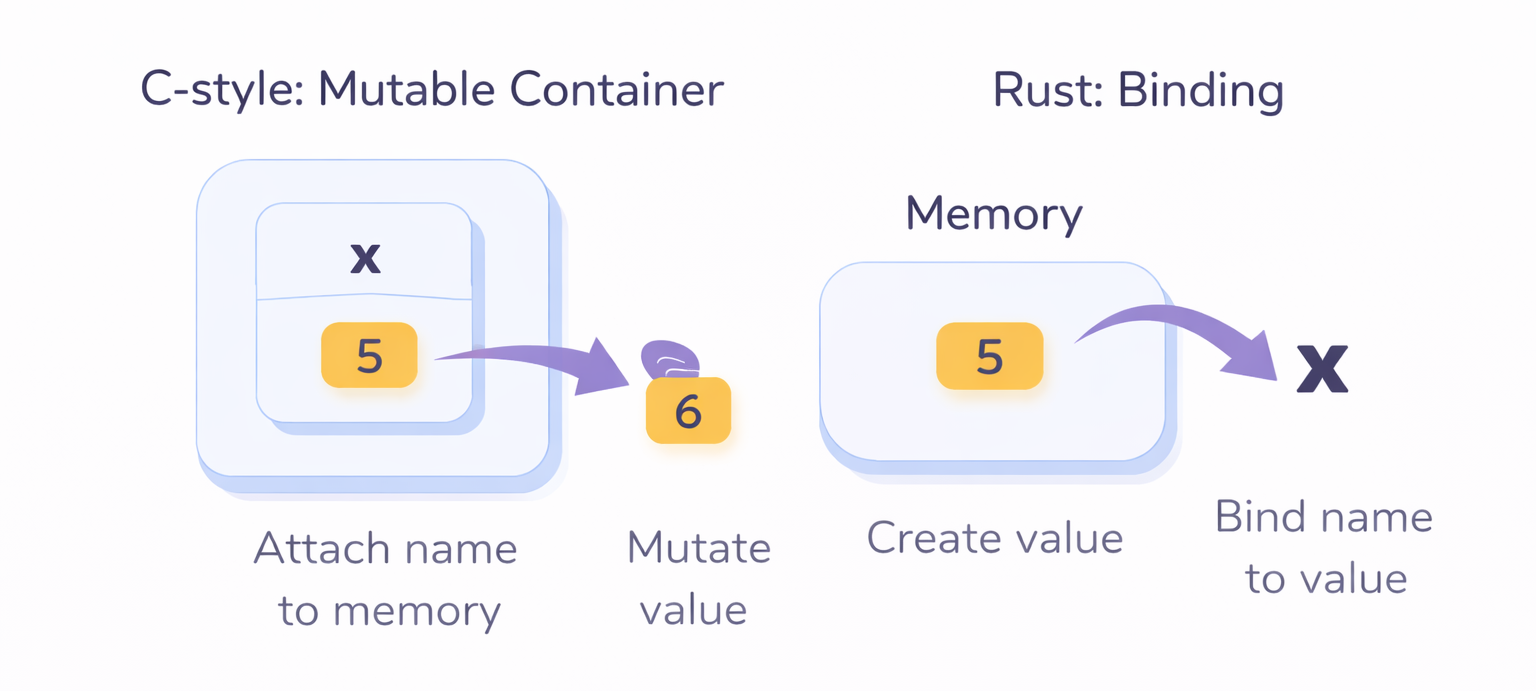
- The value (like
5) lives in memory (stack, in this case). That memory location is very real at runtime. - The name
xlives in the compiler’s symbol table (the name is a compile-time binding), not as a runtime object. Tracked in the compiler’s internal data structures. Not something you can take the address of.
Notably:
- You are not creating a “box” that later gets overwritten
- You are not reserving memory and mutating it by default
You are simply saying:
“For this scope, x refers to this value.”
Why Rust avoids “assignment” by default
In many languages:
int x = 5;
x = 6;   // same variable, new value
This encourages thinking of variables as containers that change over time.
Rust intentionally flips that model:
let x = 5;
x = 6; // ❌ not allowed
Because x is a binding, not a mutable container.
If Rust allowed this by default, it would:
- Complicate reasoning about aliasing
- Make borrow checking far harder
- Allow subtle bugs where values change unexpectedly
Instead, Rust asks you to be explicit.
let x = 5;
let mut y = 5;
Constants
In contrast to variables, constants are:
- Always immutable
- Declared with the
constkeyword - Required to have an explicit type annotation
- Must be initialized with a compile-time constant expression
- Scoped like any other name (they’re visible only within the scope they’re declared in)
const CONST_VALUE: u32 = 1337;
// Convention: constants are usually SCREAMING_SNAKE_CASE
Shadowing
We briefly mentioned shadowing earlier; here’s the precise idea.
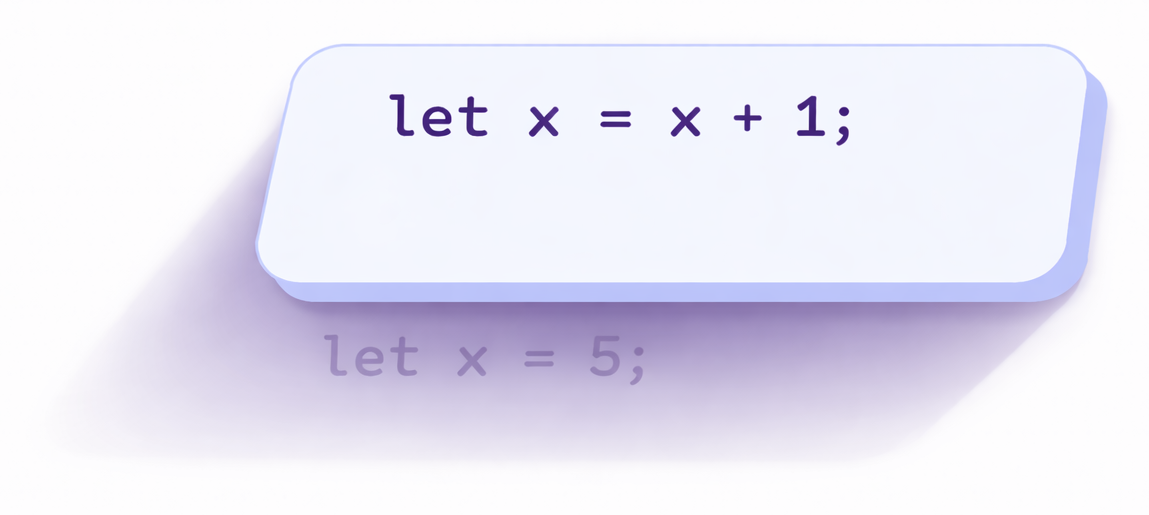
Shadowing means declaring a new binding with the same name as an existing one. The old binding still exists conceptually, but it is no longer accessible by name.
let x = 5;
let x = x + 1;
What’s important here is that:
- This is not reassignment
- A new value is created
- A new binding named
xreplaces the old one in the current scope
A helpful way of visualizing this (new x is overshadowing the first x):
What is the purpose of shadowing?
- Shadowing avoids mutation while allowing transformation
With an immutable binding, reassignment is not allowed:
let x = 5;
x = 6; // ❌ not allowed (reassignment)
But creating a new binding is allowed:
let x = 5;
let x = x + 1; // ✅ allowed (new binding)
You’re not changing a value; you’re binding the same name to a new value.
- Transform a value while keeping the same “conceptual name” A common case is parsing user input:
let guess = "42";              // &str
let guess: u32 = guess.parse().expect("number"); // u32 (new binding)
Here:
- The first
guessis a string slice - The second
guessis a number - The name stays the same because the idea (“the user’s guess”) stays the same
This works because shadowing creates a new binding, not because Rust allows mutation.
Basic Types
Revisiting Type Inference
Similar to other programming languages, Rust also has a set of basic data types.
What’s important in Rust, however, is that every value has a concrete type, and that type must be known by the compiler at compile time.
Before moving forward, let’s briefly revisit type inference, which we’ve mentioned earlier.
A quick question; will this code work?
let guess = "42".parse().expect("Not a number");
The answer is...
No, because Rust does not know what tpye you want to parse into.
What does that mean?
Let’s take a closer look.
Why let x = 5; works
let x = 5;
Here, Rust can infer the type.
Because:
- Integer literals like
5have a default type - Rust defaults to
i32when no other context is provided - In other words, the literal
5already carries enough information to reach into a default choice.
Why parse() is different
On the other hand,
"42".parse()"
doesn't work because, the signature of parse is roughly:
fn parse<T>(&self) -> Result<T, T::Err>
where
    T: FromStr
Key point:
Tis a generic typeTis not fixed- It could be
i32,u32,i64,usize,f64, etc.
So when Rust sees this line, it effectively asks:
“You want to parse this string, but into what type?”
At that point, there simply isn’t enough information yet.
How Rust normally infers parse() types (there is a small surprise in here)
parse() types (there is a small surprise in here)- Explicit annotation
let guess: u32 = "42".parse().expect("Not a number");
Now the compiler knows exactly what T is supposed to be.
- Inference from later usage
let guess = "42".parse().expect("Not a number");
let x: u32 = guess;
At first glance, this may look confusing, guess is declared before its type is known.
So why does this compile?
This is due to bidirectional type inference / constraint solving during compilation.
Rust does not type-check each line in isolation and permanently “lock in” types immediately.
Instead, the compiler:
- Builds constraints as it parses/type-checks expressions.
- Propagates type information from uses back to definitions.
- Solves them together (per item / function body) before it commits to final types.
Conceptually, here's what happens
When the compiler sees
"42".parse()
It knows:
parse()returnsResult<T, _>- therefore
guesswould beTafter.expect(...) - but
Tis unknown (yet)
So Rust keeps guess as “some type T” with the constraint: T: FromStr.
- Then it sees:
let x: u32 = guess;
That adds a new constraint:
guessmust beu32
Now the earlier unknown T becomes u32, and everything resolves.
- Method call requires a specific type
let guess = "42".parse::<u32>().expect("Not a number");
Here, ::<u32> explicitly tells the generic method parse what T should be.
Scalar Types
A scalar type represents a single value.
There aren’t many surprises here, so for readers who want more detail, refer to:
https://doc.rust-lang.org/book/ch03-02-data-types.html#scalar-types
A summary of all scalar types in Rust:
| Category | Type | Description | Notes |
|---|---|---|---|
| Integer (signed) | i8 | 8-bit signed integer | −128 to 127 |
i16 | 16-bit signed integer | ||
i32 | 32-bit signed integer | Default integer type | |
i64 | 64-bit signed integer | ||
i128 | 128-bit signed integer | ||
isize | Pointer-sized signed integer | Depends on architecture | |
| Integer (unsigned) | u8 | 8-bit unsigned integer | 0 to 255 |
u16 | 16-bit unsigned integer | ||
u32 | 32-bit unsigned integer | ||
u64 | 64-bit unsigned integer | ||
u128 | 128-bit unsigned integer | ||
usize | Pointer-sized unsigned integer | Used for indexing | |
| Floating-point | f32 | 32-bit floating point | |
f64 | 64-bit floating point | Default float type | |
| Boolean | bool | Boolean value | true / false |
| Character | char | Single Unicode scalar value | 4 bytes, not ASCII-only |
A summary of numeric literal forms in Rust:
| Literal form | Example | Meaning |
|---|---|---|
| Decimal | 42 | Base-10 integer |
| Decimal (underscores) | 98_222 | Same as 98222 (readability only) |
| Hexadecimal | 0xff | Base-16 |
| Octal | 0o77 | Base-8 |
| Binary | 0b1010 | Base-2 |
| Floating-point | 3.14 | f64 by default |
| Float (explicit) | 2.0f32 | Explicit float type |
| Integer (explicit) | 42u8 | Explicit integer type |
| Scientific notation | 1e6 | Floating-point (1_000_000.0) |
A very common confusion: char vs &str vs String
char vs &str vs StringThese three often look similar, but they represent very different concepts.
char
let c = 'a';
- A single Unicode scalar value
- Fixed size (4 bytes)
- Not a string
&str
let s = "hello";
- A borrowed string slice
- Immutable
- Points to UTF-8 text stored elsewhere
- Very cheap to copy
String
let s = String::from("hello");
- An owned, growable string
- Heap-allocated
- Mutable (if the binding allows it)
Why this matters
Many Rust APIs distinguish between:
- borrowed text (
&str) - owned text (
String)
Understanding this distinction becomes critical once ownership and borrowing rules are introduced.
Compound Types
A compound type group multiple values into one type. There are two primitive compound types in Rust: tuples and arrays.
Tuple
let tup: (i32, f64, u8) = (500, 6.4, 1)
A tuple is a general way of grouping together a number of values (possibly of different types) into a single compound value.
Key points:
- Tuples have a fixed length
- In the example above, the name
tupis bound to the entire tuple, because the tuple itself is a single value
A programmer can destructure a tuple to access its individual elements.
Using the same example again:
fn main() {
    let tup = (500, 6.4, 1);
}
Here are several common ways to access tuple elements.
- Direct access:
println("second = {}", tup.1);
- Ignore elements with
_:
let (_, x2, _) = tup;
println!("{x2}");
- Destructure nested tuples
let tup = ((1, 2), 3); // original code slightly modified
let ((a, b), c) = tup;
println!("{a} {b} {c}");
- Destructure in
match
match tup {
    (a, b, c) => println!("{a} {b} {c}"),
}
- Destructure in function parameters
fn print_second((_, second, _): (i32, f64, i32)) {
    println!("{second}");
}

fn main() {
    print_second((500, 6.4, 1));
}
- Borrow instead of move using
ref
fn main() {
    let tup = (String::from("text"), 6.4, 1);

    let (ref s, x2, x3) = tup;
    // s: &String (borrowed) | x2, x3: copied (f64 and i32 implement Copy)

    println!("{s}, {x2}, {x3}");
    println!("{}", tup.0); // still usable because the String was not moved
}
Why destructuring exists
Destructuring is part of Rust’s general pattern matching system. It allows you to:
- bind multiple names at once (
(x1, x2, x3)) - ignore values you don’t care about (
_) - control ownership when extracting values (move vs borrow vs copy)
Move vs Copy vs Borrow in destructuring
So one of the points made earlier was: Borrow instead of move using ref.
We’ll cover ownership more deeply later, but here’s a quick summary.
-
Borrow (
ref s)
sbecomes a reference to theStringstored insidetup.
No data is duplicated, and ownership remains withtup. -
Copy (
x2,x3)
x2andx3are copied becausef64andi32implement theCopytrait.
For these simple scalar types, copying is a cheap, bitwise operation. -
Move (without
ref)
let (s, x2, x3) = tup;
In this case:
Stringdoes not implementCopy- ownership of the
Stringis moved out oftup tup.0can no longer be used afterward
This design makes sense because a String is not just raw bytes — it is a small struct containing:
- a pointer to heap memory
- a length
- a capacity
To explicitly duplicate the string data, you must opt in:
let s = tup.0.clone();
This performs a deep copy of the string contents.
Array
There aren’t many surprises here, so for readers who want more detail, refer to:
https://doc.rust-lang.org/book/ch03-02-data-types.html#the-array-type
In next section, we will discuss about how functions work in Rust.